
This is not your typical dog GPS tracker comparison article or review. I have been involved in lost pet recovery work since 2009, and, yes, I will recommend what I believe are the best dog GPS trackers on the market today. But there is no best tracker that I recommend for every dog.
Lost Pet Research participates in affiliate referral programs including Amazon Associates. If you purchase anything via an affiliate link, I may receive a small commission at no cost to you. Learn more here.
The best GPS tracker for your dog will depend on several factors including:
- Your dog: what size are they and what type of tracker and collar will work for them?
- Your dog's behavior: why are they likely to go missing and how easy will it be to catch them once located?
- Your behavior: how good are you at remembering to keep your tracker charged?
- Your budget: what can you afford? There is the cost of the tracker and an annual subscription fee.
- Your phone: does the tracker app get good reviews for your operating system?
- Your location: what cell coverage do you have where you live and travel with your dog?
Use this article to help determine what is probably the best tracker for your dog, but in the end you will need to test the tracker out. I will provide some testing instructions and results of my own tests at the end of this article. Fortunately, many trackers come with a 30-day satisfaction guarantee return policy. Be aware that you may need to purchase the tracker directly from their site, and be sure to check out their current return policy.
Based on my research and discussions with other lost pet specialists, the best dog GPS trackers in the US are Fi and Tractive. So far, I have tested the Tractive Dog 6 and the Fi Series 3 and 3+. This article was last updated in June 2026 and I plan on doing new testing this fall including possibly the new Fi Mini.


Last update on 2026-09-27 / Affiliate links / Images from Amazon Product Advertising API
Dog Size and GPS Tracker Design
To find the best GPS tracker for your dog, start with the size and design of the tracker. GPS trackers can be bulky, so you want to make sure you get one that isn't too big for your dog. However, larger trackers tend to have a longer battery life, which is one of the most important features of a GPS tracker.
Dog size and trackers available
GPS Tracker | Tracker Weight | Recommended Pet Size |
|---|---|---|
Fi Mini | 0.56 oz. (16g) | 8+ lbs. |
Tractive Cat Mini | 0.88 oz. (25g) | 6.6+ lbs. |
Tractive Dog 6 | 1.4 oz. (39g) | 9+ lbs. |
Fi 3+ | 1.66 oz. (47g) | 10+ lbs. |
Tractive Dog 6 XL | 2.5 oz. (70g) | 44+ lbs. |
Tractive Dog XL Adventure | 4.1 oz. (115g) | 55+ lbs |
Table 1: Dog GPS tracker weight and recommended pet size.
There aren't any trackers for really tiny dogs, but the Tractive version for cats is advertised for 6.6 lbs and up. If purchasing for a dog, be sure to buy the older Cat Mini and not the new Cat 6 Mini, which is built into a cat safety collar. The Fi Mini is rated for dogs over 8 lbs, but it is actually lighter than the Tractive Cat Mini.
Dog GPS tracker design and collars
Dog GPS collars generally come in two designs: those that are integrated into the collar, and those that will attach to most collars. The Fi Series 3+ is integrated into the collar, which makes it less bulky. The Fi 3+ collar is made of heavy duty material, and is 3/4" wide for XS and S sizes and 1" wide for M, L and XL. The medium collar looked uncomfortably large on my small (35 lb) Australian Cattle Dog. However, I have since learned that other companies sell collars and harnesses that are compatible with Fi trackers.
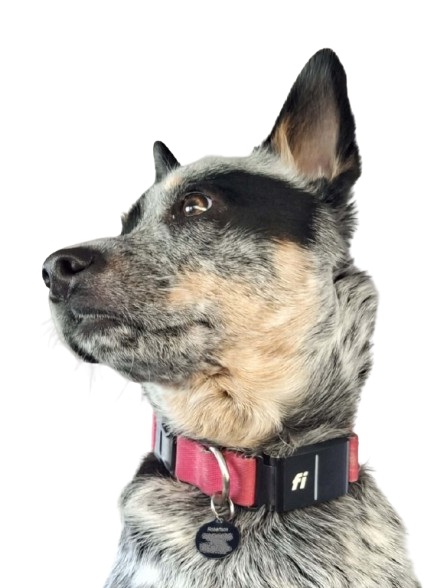
Australian Cattle Dog (35 lbs) wearing Fi 3 with medium collar.
The only other issue I had with the Fi collar is that you have to make it quite snug or your dog could pull out of the collar if they got scared or excited. (My dog has done this since I last updated this article). For a skittish or reactive dog, I would recommend walking the dog with a separate martingale collar, or opting for a tracker that will attach to a martingale collar or harness. There are Fi compatible martingale collars for sale by Mimi Green and other sellers.

Australian Cattle Dog (35 lbs) wearing Tractive (front) and Whistle (left side) GPS trackers.
The Fi Mini and Tractive Dog 6 can attach to most collars or harnesses. If you have a favorite collar already, these may be the way to go. The only downside is that the tracker could get pulled off the collar if your dog wrestles with other dogs or runs loose through the woods. This seems uncommon, but I saw a few complaints in reviews for the Tractive.
Waterproof rating and durability
Other factors to consider, depending on your dog, are the waterproof rating and durability of the tracker. All the trackers had the same waterproof rating of IP68. This means that the device is completely dust-tight and protected against submersion in water (usually up to 1.5 meters deep for 30 minutes). Only the Fi 3+ had an IP68 +66K rating, which includes protection against high speed jets of water.
The Fi 3+ tracker is made of a stainless steel case and band attachment. The Tractive Dog 6 and Tractive Dog XL Adventure advertise a "bite-proof" fiberglass casing. Other trackers are less durable and may be damaged by chewing.
The Importance of Battery Life
Once you know what trackers will fit your dog, the most important factors to consider are:
- Battery life. How long does the battery typically last, and how long does it last when in Lost Dog Mode?
- Connectivity. Does the tracker have good cell coverage where you live and travel with your dog?
- Accuracy. Does the tracker quickly connect and provide accurate locations of your dog, especially in Lost Dog Mode?
Long battery life is so important because if your dog goes missing, you will need to turn on Lost Dog Mode (called LIVE mode in Tractive). In this mode, the tracker takes more frequent locations, and this will drain the battery much more quickly, perhaps within hours and at most a couple of days.
Long battery life is most important if ...
Battery life is most important if your dog is skittish, has phobias, or is newly adopted because these dogs can take longer to catch when they go missing. When a skittish or panicked dog goes missing, they often enter "survival mode" and are likely to run from everyone and not even respond to their owner's voice. If you understand lost dog behavior, you may be able to lure your dog to you with calming signals. But many skittish and/or newly adopted dogs need to be caught using surveillance cameras and humane traps (or an enclosure trap). Trapping a skittish lost dog can take days or weeks even if you know where your dog is located.
IMPORTANT! If you have a skittish dog or one with phobias (such as fear of loud noises), make sure that you understand lost dog behavior before your dog goes missing. If you use your GPS to find your lost dog and approach them directly or call to them, you are likely to scare them away. If you keep doing this, you will drain your dog's GPS battery without catching them. You could also scare your dog out of a safe area and into somewhere dangerous like a busy road.
Some lost dog recovery groups don't recommend GPS collars for skittish dogs. And I agree that if you don't understand lost dog behavior, they are not a good idea. They can also lead owners to be less cautious and allow skittish dogs off lead because they think they can find and catch them if they run off. But having a skittish dog myself, I would never let her outside without a tracker.
Some trackers, like Tractive, also have a sound locating feature. If you have a skittish lost dog, NEVER use the sound feature to try to locate your dog. This could scare them and cause them to run away.
Some skittish or panicked dogs can be caught without a humane trap, but you need to know what you are doing. In particular, you may be able to use calming signals to get your lost dog to approach you. Learn more about lost dog behavior and calming signals here.
Once you have located your lost dog, turn off Lost Dog Mode to preserve battery life and try calming signals to get them to approach you. If this does not work, keep Lost Dog Mode off (unless your dog is in a dangerous area) to preserve battery life as long as possible. Contact a pet detective or other lost pet specialist as soon as possible for professional advice and/or on-site help to improve the chances of catching your dog quickly.
Longer battery life is also helpful if you are someone who probably won't remember to charge the tracker regularly. I have had many calls about lost dogs and cats wearing GPS trackers that weren't charged when the pet went missing.
Long battery life is less important if ...
If your dog is easy to catch once located, then battery life is somewhat less important. These are usually confident, friendly or even aloof dogs. These dogs tend to go missing because they get out of the yard to explore or take off after wildlife while on a hike. Most important, they are off having a good time and aren't scared.
That said, even an otherwise friendly, confident dog may go into survival mode if they experience a traumatic event. For example, if they are attacked by another dog or are in a car accident.
Types of battery life to consider
Whatever tracker you choose, make sure to check the stated battery life. Most trackers will state a battery life up to a certain number of days, weeks, or months. This may indicate estimated typical battery life or maximum battery life.
- Maximum battery life. Most trackers use Wi-Fi when at home and allow you to set up one or more Safe Zones. If your dog primarily stays within Wi-Fi range, the tracker battery will last the longest because it is not using power to connect to satellites or send cellular data.
- Typical battery life. This will depend on how active your dog is, where you live, and where you travel. If you spend a lot of time away from home, your average battery life will be much lower. Once you get your tracker, you should keep track of how long the battery tends to last on your dog.
- Battery life in Lost Dog Mode. When set to Lost Dog Mode (or LIVE Mode), the tracker will increase the frequency of location updates, which will drain the battery quickly.
Other factors that can impact battery life include cellular coverage, GPS availability, and temperature. Poor cell coverage will use more battery. The GPS connects most easily outdoors and under a clear sky. If your dog is indoors (and not in a Safe Zone), the tracker will use more power trying to connect to GPS. Batteries also drain more quickly in very cold or hot temperatures
Battery Life Comparison
GPS Tracker | Stated Battery Life | Battery Life While Traveling* |
|---|---|---|
Fi 3+ | up to 3 months | 1 to 3 weeks |
Fi Mini | up to 2 months | 1 to 3 weeks |
Tractive Dog 6 XL | up to 42 days | up to 20 days |
Tractive Dog XL Adventure | up to 30 days | up to 15 days |
Tractive Dog 6 | up to 14 days | up to 6 days |
Tractive Cat 6 Mini | up to 7 days | up to 4 days |
Tractive Cat Mini | up to 5 days | up to 2 days |
Table 2: Battery life comparison for Fi and Tractive GPS trackers. *While Traveling means away from the base station, Wi-Fi and/or Safe Zones.
Most companies did not want to state or speculate on battery life in Lost Dog Mode. This is unfortunate since this is arguably the most important number. Fi 3+ states an estimated battery life of up to 2 days when in Lost Dog Mode on a fully charged device.
Battery Life Testing Results
I tested typical battery life for the Fi Series 3, Whistle and Tractive Dog 6. Keep in mind that my test is only accurate for my location (Pioneer Valley of western Massachusetts), my dog's activity, my traveling, and my phone (Samsung Android on AT&T).

Figure 1: Battery life test of Fi 3, Whistle Go Explore 2.0 and Tractive Dog 6 at home.
A few notes on my testing. The first day I was away from home for 12+ hours. The drop in battery life on 5/28, 29 and 31 was due to increased testing of Lost Dog Mode. All other days, my dog was at home and included 2 to 4 hours away from home each day. Whistle is now discontinued. I plan to add a new chart this fall with Fi 3+, Fi Mini and Tractive Dog 6.
I also ran two battery life tests while traveling on camping trips. On the first and last days I was driving for 1 to 2.5 hours. I was camping in areas with decent cell reception, but driving through areas with poor reception. I didn't test Lost Dog Mode so this is just default tracking mode drain on the battery when away from home.
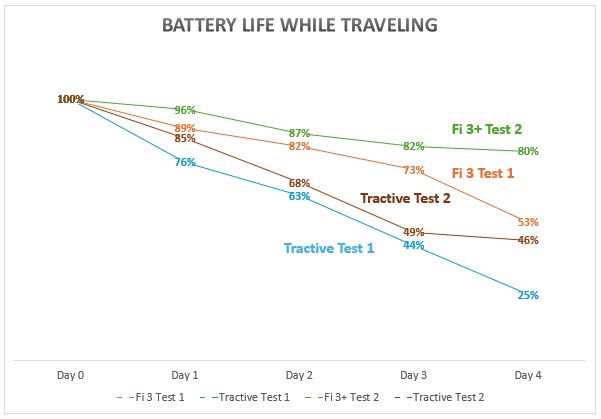
Battery life tests of Fi 3, Fi 3+, and Tractive Dog 6 on two camping trips.
As predicted Fi had much better battery life than Tractive on both trips. But there is a lot of variability in the results between trips. In Test 1, the Fi 3 drained almost as much as the Tractive in Test 2. When traveling, you should expect more variability in battery life. The battery will drain more quickly if you are driving, your dog is very active or you are in an area with poor cell service.
I am still testing how quickly the battery will drain in Lost Dog Mode. I will update this article after more testing.
Battery Life Testing Suggestions
Once you get a tracker, you should keep track of your average battery life. Compare your results to the Battery Life Comparison Table (2). Also if possible, try taking your dog to any areas farther from home that you occasionally visit. See how quickly your battery drains on these trips. Lastly, try running Lost Dog Mode for at least 15 to 30 minutes somewhere that you regularly take your dog. How quickly does the battery drain? You can do this while walking your dog if you turn off Bluetooth on your phone.
Personally, I would only suggest completely draining the battery once. After that, you can do most battery tests to 50% power so you don't risk having an empty tracker if your dog actually goes missing. In fact, I would recommend charging your tracker at 50% power or even more frequently as a general rule. It's great that some trackers will last for weeks before needing to be charged, but the battery will drain very quickly if you have to use Lost Dog Mode for any length of time. It's best to be prepared and have a charged battery, especially if you have a skittish or newly adopted dog.
Best Dog GPS Trackers for Battery Life
The Fi Series 3+ and Fi Mini have by far the best battery life. However, if you have a large dog over 50 lbs, the Tractive Dog XL and XL Adventure also have relatively long battery life.
Use this Referral Link to receive $20 off a Fi Series 3+ or Fi Mini GPS collar and 1 month of free Fi Membership!


Last update on 2026-09-26 / Affiliate links / Images from Amazon Product Advertising API
Cost of Dog GPS Trackers
With most GPS trackers, you need to purchase the tracker and then purchase a subscription plan. One exception is Fi, which has you purchase a membership plan and the collar is usually included (at least the first collar you purchase). Overall, Tractive GPS trackers tend to be cheaper, and often have discount codes and sales. Tractive also has the largest variety of plans available.
Costs, of course, are subject to change, but here's a comparison of costs from June 2026 from the companies' websites. You may be able to get a lower annual cost by purchasing several years in advance. Only Fi offered a six month plan.
GPS Tracker | Cost of Tracker | Cost of Annual Subscription | Total First Year* |
|---|---|---|---|
Fi Mini | first collar free $20 activation fee | $189 | $209 |
Fi Series 3+ | first collar free $20 activation fee | $189 | $209 |
Tractive Cat Mini | $49 | $120 | $169 |
Tractive Dog 6 | $79 | $120 | $199 |
Tractive Dog XL | $89 | $120 | $209 |
Tractive Dog XL Adventure | $99 | $120 | $219 |
Table 3: Cost comparison of Fi and Tractive GPS trackers. *The total for the first year includes the cost of the tracker and a one year subscription. After the first year, you will only need to pay for the subscription until your tracker breaks, gets lost or you want to upgrade.
When considering costs, you may also want to check the company's current warranty. How long is it and what does it cover? As of June 2026, Fi had a one year warranty, and Tractive offered a two year warranty. In addition they also offered Tractive Care for $24 annually, which may provide you with a free or discounted tracker if yours is lost, damaged or stolen.
Check the Ratings of the Tracker App
Most dog GPS trackers work with an app on your cell phone. Before selecting a tracker, take a quick look at the app ratings for your phone operating system. I had a lot of issues while testing the Whistle Go Explore 2.0. It's likely this was partly due to the Whistle app that I was using, which only had 2.1 stars in the Google Play store. Whistle has since been bought out by Tractive and discontinued.
Will the Tracker Work Where You Live and Travel?
The last factor to check before purchasing a dog GPS tracker is whether it is likely to work where you live and travel with your dog. Dog GPS trackers work by getting a location via satellites and then sending that location to your cell phone app using cellular data and/or Bluetooth. In order to receive that location, both the GPS tracker and your phone need cell coverage. Your phone can also work via Wi-Fi, but this will make tracking your dog much more difficult since you will need to stay in the Wi-Fi zone.
Fi Series 3+ works in the US, Canada and Mexico, but the Fi Mini only works in the US. The Fi Mini uses Verizon LTE-M and the Fi Series 3+ uses the AT&T LTE-M network. The LTE-M network (also called LTE Cat-M) is a low-power, long-distance cellular network that reaches farther than conventional networks like 4G, 5G, and LTE. To check your coverage for the Fi Mini, go to verizon.com/coverage-map and make sure to select "LTE" or "4G LTE" coverage. To check your coverage for the Fi Series 3+, go to AT&T's coverage map.
Please note that not every LTE tower has LTE-M enabled, so in some rural areas you might have LTE on your phone but the tracker still won't connect. The coverage maps don't currently distinguish LTE from LTE-M at the tower level, so they give you a reasonable approximation but not a perfect answer.
Tractive uses AT&T, Verizon and T-Mobile LTE networks in the US. Tractive is also the one popular US tracker that works in many other countries. With over 500 partners around the world, their trackers can connect to 2G and/or LTE (CatM1) cell networks in over 175 countries. You can check Tractive coverage at your address here.
IMPORTANT! If you live or primarily travel somewhere without cell phone reception, the dog GPS trackers discussed here will not work. You will need to purchase a tracker that works without cellular service like the Garmin Alpha 300i Handheld with Alpha TT25 Tracker or Dogtra Pathfinder 2.
Testing Tracker Connectivity and Accuracy
Once you have selected a dog GPS tracker based on design, battery life, cost, app ratings and cell coverage, you need to buy and test the tracker. Fortunately, many trackers offer a 30-day satisfaction guarantee. Be sure to check out their current refund policy before purchasing. You may need to purchase directly from the company, and the 30 days may start at purchase or at activation.
Don't wait until your dog really goes missing to find out how well your tracker works! I tested out the Fi Series 3 and Tractive Dog 6. I'll share my experience, but how well your tracker works will really depend on where you live and travel. This fall I plan to add updated tests with the Fi Series 3+ and Fi Mini.
Testing Safe Zone Alerts
Once you get your tracker, you should set up a Safe Zone (aka Power Saving Zone) right away. If your dog leaves this area, you will receive a notification on the tracker app. One important factor of a good GPS tracker is how quickly you get an alert that your dog has left their Safe Zone. This is also one way to get an idea of your connectivity.
Try taking your dog for a walk and record how long it takes before you get a notification that they have left their Safe Zone. Do this at least several times on different days to get an average. If you can't walk where you live, you can also drive, but the important factor to measure is time and not distance.
Results of my Safe Zone tests
I tested the Fi Series 3 and Tractive Dog 6. I live in an area with good cell phone coverage. Fi and Tractive usually took around 2 minutes (median). However, in 2 of 13 tests (15%), Fi took over 10 minutes to send an alert. Please note that these tests are with the older Fi 3 and not the newer Fi 3+.
GPS Tracker | Mean | Median | Range |
|---|---|---|---|
Fi 3 | 4 | 2 | 1 to 12 |
Tractive Dog 6 | 3 | 2 | 2 to 5 |
Table 4: Test of Safe Zone alerts for dog GPS trackers. Shows the number of minutes before a notification was received that the dog had left the Safe Zone.
Testing Connectivity
Next you want to check connectivity both near your home and at locations that you frequently travel with your dog. This test can be done manually as part of the Lost Dog Mode test or you can use one of the following methods:
- Fi has a GPS and LTE-M connectivity test built into the app. For step-by-step instructions, check out their support page.
- Tractive has a method to check network and GPS connection built into the tracker itself. For instructions for the Tractive Dog 6, check out their support page. There's also a link from their page for other Tractive models.
In order to test connectivity manually, you need to be outside, away from your Safe Zone, and more than 30 feet away from your dog (beyond Bluetooth range). If you don't have a helper to hold your dog, you can just test with the collar. Alternatively, you can temporarily disable Bluetooth on your phone, but the app needs to think that you and your dog are separated. Be sure to turn off Lost Dog Mode when done so you don't drain the battery.
Once you are away from your dog (or just the GPS tracker), check the current location in the tracker app. If you are using Fi or Tractive, you will probably have an up-to-date location if there is any cellular coverage. Then turn on Lost Dog Mode (aka LIVE Mode) and measure how long it takes the tracker to connect and the app to provide an updated location.
Results of my connectivity tests
I tested the Fi Series 3 and Tractive Dog 6. I live in an area with good cell phone coverage, but I also traveled to a few areas with spotty coverage.
GPS Tracker | Mean | Median | Range | Failures |
|---|---|---|---|---|
Fi 3 | 1:25 | 1:15 | 0:10 to 4:00 | 0 of 9 |
Tractive Dog 6 | 0:14 | 0:15 | 0:10 to 0:18 | 1 of 7 |
Table 5: Connectivity Test for dog GPS trackers. Number of minutes that it took the app to connect to the tracker and provide an updated location when Lost Dog Mode was turned on.
Tractive Dog 6 Test Results
The Tractive Dog 6 had by far the fastest connection speed with an average of 15 seconds. However, there was one test in rural Vermont with spotty cell coverage where it could not connect. It appears that Tractive will try to connect for about a minute before a pop up appears that states: "Connection Too Weak. Buildings or trees may be blocking coverage where your tracker is. Try again in a minute." I tried moving the tracker to another location that said my phone had service and was open to the sky, but it still would not connect.
Even though Tractive could not connect to Lost Dog Mode (called LIVE mode in Tractive), I was still getting some connection. Tractive accurately recorded our walk and other time spent in that area. So I could still get locations on my dog, but they were not updated as frequently. In default tracking mode, Tractive updates the location every 2 to 60 minutes depending on activity level of your dog. If your dog is moving, you will get more frequent updates. In Lost Dog Mode, Tractive updates locations every 2 to 3 seconds. You can learn more about the difference between Default Tracking and LIVE Mode here.

Tractive Dog 6 created an accurate track in an area with poor cell reception.
Fi Series 3 Test Results
The Fi Series 3 had a pretty consistent connection time of around 1 minute. The only time it took longer to connect to Lost Dog Mode was in a rural area of VT with spotty cell coverage. There it took 4 minutes to connect. Unlike Tractive, Fi will continue to attempt to connect to Lost Dog Mode for several minutes. If it cannot connect after 5 minutes, it gives you the option to cancel Lost Dog Mode.
Like Tractive, Fi also provided up-to-date locations in this area while in default tracking mode, but the walk recording was a little less accurate. When in default tracking mode, Fi updates locations around once every 5 minutes. In Lost Dog Mode, Fi provides "real-time" updates. I'm still testing this feature, but it seemed to provide location updates between 3 to 5 times per minute when moving depending on speed.

Fi 3 created a somewhat accurate track in an area with poor cell reception.
Testing Lost Dog Mode Speed and Accuracy
Finally, you should test your tracker in Lost Dog Mode to determine the speed and accuracy of locations once connected. Even if you have a well trained dog, I wouldn't recommend just releasing your dog in the woods and trying to find them. To find out how really accurate the GPS tracker is, you want to know exactly where your dog went and where the tracker app said that they went.
There are a few different ways to test out Lost Dog Mode. The best way is to have someone else walk your dog, put the tracker on their own dog or carry the tracker while you try to locate them. Then compare where they went with where the tracker recorded. Most important, how easy was it to find them? Fi provides step-by-step instructions on how to test Lost Dog Mode here. When testing with Tractive, you should set LIVE tracking duration to 30 or 60 minutes or it will turn off after 5 minutes (the default setting).
If you don't have someone to help you with the test, there are a few other options. Option 1: First turn off Bluetooth on your phone. Then turn on Lost Dog Mode, wait for it to connect and take your dog for a walk. After your walk, turn Lost Dog Mode off and check the Timeline (Fi) or History (Tractive) to see a recording of the walk. This will help you determine the accuracy and frequency of GPS locations. Fi provides step-by-step instructions on this method as well.
Option 2: Place the tracker somewhere where it won't be stolen then test out Lost Dog Mode and see how accurate it is. This is a good way to test whether the tracker app accurately determines your location as well as the tracker's location. Because if you don't know where YOU are, it is really hard to find your dog, especially if you are in the middle of the woods.
The second option can also be used to test out the Bluetooth tracking feature on Tractive. You have to be really close (usually within 30 feet) for Bluetooth to work, so this is most useful if your dog loses their tracker. Tractive also has a sound alert feature to help you pinpoint the location of a lost tracker.
Results of My Lost Dog Mode Tests
I tested the Fi Series 3 and Tractive Dog 6. These tests were conducted in areas with decent cell phone coverage.
Tractive Dog 6 Test Results
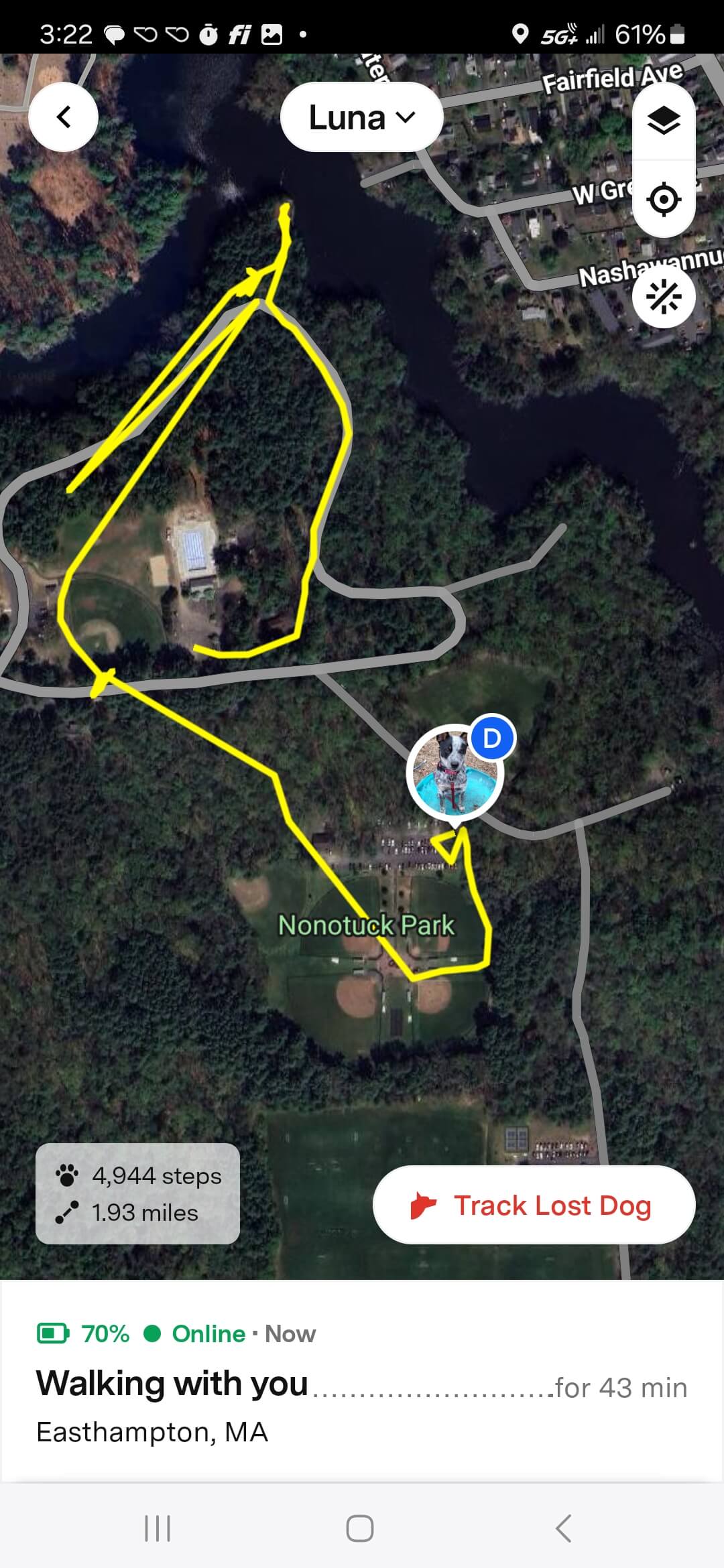
Tractive was the easiest to use and the most accurate. When using Lost Dog Mode (called LIVE mode in Tractive), the app shows your dog's location, your location and their path of travel. Tractive updates locations every 2-3 seconds in Lost Dog Mode so it provides a very detailed path of travel. The downside of course is that battery level drops quickly.
Once close, you can turn on Radar mode, which is the Bluetooth feature on Tractive. Since you have to be really close, Bluetooth probably isn't useful unless you are looking for a lost tracker. In this case, Tractive has the best features since Bluetooth will even work in the Safe Zone if your dog loses their tracker at home. There is also a sound feature on Tractive to help you pinpoint the location, but it's not very loud.

Tractive Dog 6 GPS track during Lost Dog Mode test.
Fi Series 3 Test Results
Fi 3 overall worked well, but was a little more difficult to navigate than Tractive and had some glitches. When in Lost Dog Mode, the Fi app shows your dog's location and your location, but it doesn't show their path of travel. During this test, my location did not update frequently, so it was difficult to tell where I was. However, Fi has the option to get directions in Google Maps. When I did this, my location was updated. This is a good backup option to check where you are, but your dog's location will not update when in Google Maps.
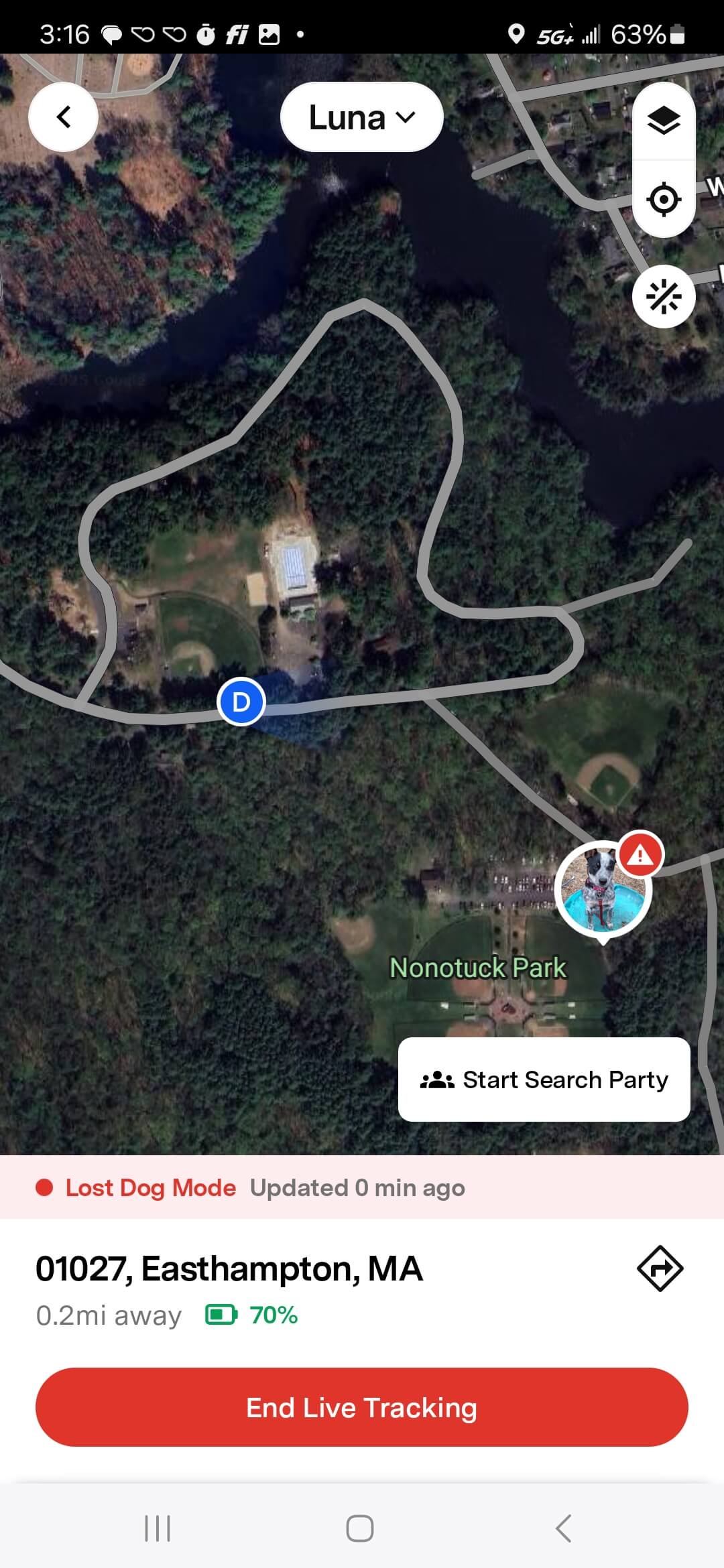
Fi 3 Lost Dog Mode test.
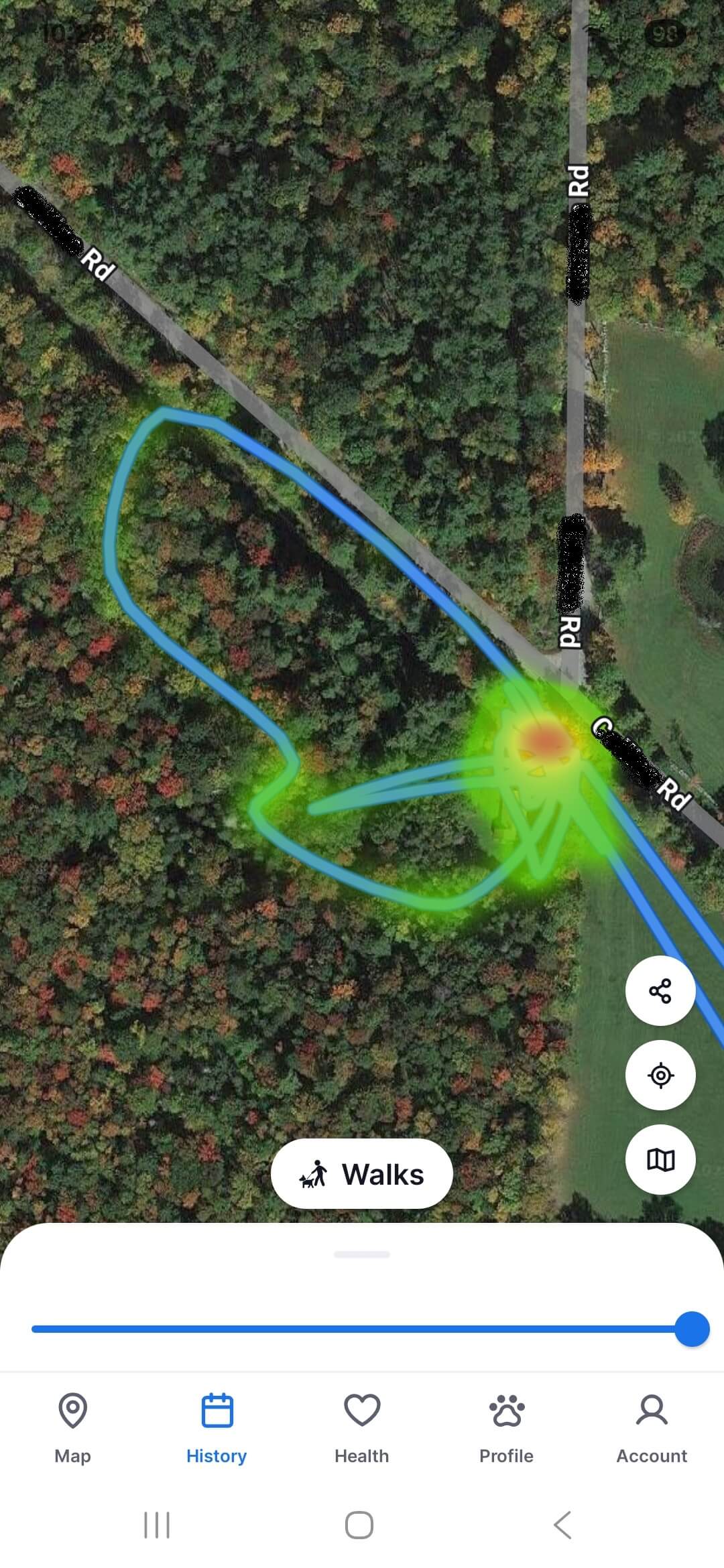
In the Fi app, your dog's path of travel is recorded under the Timeline, but you can't view it until you turn off Lost Dog Mode. The path of travel recorded by Fi during the Lost Dog Mode test was less accurate than Tractive. There were a few glitches where the location jumped around. Overall, I have found that Fi tracks are sometimes very accurate and other times have some inaccurate locations that cause the track to jump around.
Fi uses Bluetooth, but doesn't have a separate Bluetooth tracking feature like Tractive. When you get close, your icon will appear attached to your dog's icon in the app. This can make locating them more difficult if they are hiding, but you could try switching to Google Maps for a (hopefully) more accurate location.

Fi 3 GPS track recorded during Lost Dog Mode test.
My Recommendations
If cost is not an issue, I definitely recommend the Fi Series 3+ or Fi Mini (though I haven't tested this one yet). Fi has by far the best battery life and was generally accurate. It provided location updates 3 to 5 times per minute in Lost Dog Mode and at least every 5 minutes in regular tracking mode. But don't forget, you will still need to test the tracker to make sure that it works for your dog. Fi Series 3+ uses AT&T while the Fi Mini uses Verizon.
Use this Referral Link to receive $20 off a Fi Series 3+ or Fi Mini GPS and 1 month of free Fi Membership!
With the exception of battery life, the Tractive Dog 6 was a great tracker. If anything, it was more accurate and updated lost dog locations more frequently than the Fi 3. Tractive also updates locations every 2 to 60 minutes in default tracking mode, so you don't need to waste battery life using Lost Dog Mode unless you really need it. If you have a larger dog, I would probably recommend one of the Tractive Dog XL trackers for improved battery life (though I did not get to test these). The Tractive trackers are more budget friendly and frequently have sales. Tractive is also the only tracker that works in many countries other than the US.
If you have a skittish dog, I would recommend Fi over Tractive. When a skittish dog goes missing, they often go into "survival mode" and are likely to run from everyone and not even respond to their owner's voice. Many skittish, panicked and/or newly adopted dogs need to be caught using surveillance cameras and humane traps (or a large enclosure trap). This can take days or weeks even when you know the location of your lost dog. Long battery life is essential. That said, the Fi Series 3+ collar itself is not great for skittish dogs because they might pull out of it. I would recommend walking a skittish dog on a separate martingale collar or buy a Fi compatible martingale collar or the Fi Mini.
Sources and Notes
Fi product and support pages. Support pages were detailed and updated.
PC Magazine Review of the Fi Smart Dog Collar Series 3.
Tractive product and support pages. Support pages were detailed and updated. Some useful pages include:



Pingback: Airtag Dog Collar: 7 Best Ways To Ensure Recovery (Proven Guide)